Showing posts with label mass. Show all posts

Friday, August 14, 2015

Fr. Hollowell:"Mass Needs to Be Just What I Want"

 "My Faith isn't shaken by crappy Church architecture 
My Faith isn't shaken by music at Mass that is off key and strained 
My Faith isn't shaken by bored servers dressed in ratty garb 
My Faith isn't shaken by there not being a communion rail 
My Faith isn't shaken by priests celebrating Mass facing the people 
My Faith isn't shaken by Mass trending towards a cult of personality around the celebrant 
My Faith isn't shaken by 48 people distributing Holy Communion at every Mass 

The problem is...I'M NOT THE STANDARD FOR WHAT MASS SHOULD BE! 

The Church's requirements for the Mass aren't based on what will or will not affect MY PERSONAL Faith 

The Church has set up the Mass in a certain way so as to help strengthen the Faith of people who visit and DON'T know what we believe when they walk in. 

St John Vianney, Blessed Mother Teresa, St. Francis and countless others preached and lived RADICAL POVERTY but also wrote extensively and also actually built beautiful Churches, secured beautiful vestments, etc."

Read the rest of his post HERE (BTW, can someone inform Deacon Kandra and the Patheos folks that female lectors are not necessary... is it really that hard for the priest to read all three letters?)

Monday, March 3, 2014

On the Fisher More situation (Calm down, and pray)

Last night I came across a tweet from Rorate that read the following:


My initial thought was:  "Dang nab it!  Don't these prelates understand that they are stoking and not calming
the fires of Lefebvrian drift".  I admit that I am very concerned about some within the traditionalist movement seeing this and becoming more paranoid (rightly or wrongly) about the continued persecution of traditional teachings and practices of the faith.  There are some circles that see traditionalism as an ends rather than a means to sanctification.  We need first remember that the end is Christ. Period!! Jesus is the Point to all this, and we deserve the frustrations that are put in our way, and are expected to make the best of what we have because it is part of God's just will.

Fr. Z makes some interesting points on this matter in his recent article

Fr. Z’s first reaction to Bp. Olson banning Extraordinary Form at Fort Worth’s Fisher More College


That said, what we don’t know about this situation could fill volumes.For example, I discern in the bishop’s second point, the one about his granting faculties, the possibility that the priest who had been saying Mass at Fisher More on a regular basis may not have had any faculties at all, from any bishop or religious superior.  I suspect that there is more to that poorly phrased second point than meets the eye.
Also, while some Catholic college and university chaplaincies also have the canonical designation as a parish (e.g., St. Paul’s at the University of Madison), Summorum Pontificum doesn’t seem to apply as clearly.  The Motu Proprio doesn’t seem to apply to college chapels and chapels on military bases.  That said, the spirit of both Summorum Pontificum and Universae Ecclesiae communicate something far different from the tone, at least, of the bishop’s letter.
A commentator also made an interesting point in Creative Minority Reports account of the matter:

federoff11 said...
There is much more to the story, but I am not allowed to talk about it. This isn't an attack on the TLM, its the problems with FMC (and its feeder school FMA). I see no good reporting here, trying to get to the underlying issues by talking to the staff that has left FMA recently.
MARCH 3, 2014 AT 9:33 AM
 This reminded me of Taylor Marshall.  You probably know him from his old blog Canterbury Tales. Dr. Marshall was made Chancellor of the College about 2 years ago, and yet within a half a year resigned leaving many questions.  Nothing official was said by the college or by Dr. Marshall himself, but this does support the possibility that there might be some underlying issues that would play into this decision.

The Holy Father Francis told the Personal Apostolic Administration of St. John Mary Vianney (Campos, Brazil), Bp. Fernando A Rifan that "[Pope Francis] thinks that the Traditional Latin Mass is a treasure to the Church and that his only fear is that the Holy Mass in the Extraordinary Form could be “instrumentalized”

Some might ask what this could mean, but I think it is clear and just.  People using traditionalism and its practices as a way to deny Church authority in disciplinary matters (in a just manner of course). I would point readers to a controversy in the 1400's in the Latin rite where the Ultraquist's were given permission to offer communion under both species.  They did so with the intention of using it as an instrument in deny rightful Church authority in distribution of the sacraments (a discipline as the mass is itself). They were then suppressed for their abuse.

I do pray this situation will be cleaned up soon and the information necessary to calm things down be made public to do so.  Until such times PRAY for all involved!  And dont assume the worst on the part of the Bishop or those reporting on the matter.

+JMJ+

Wednesday, January 22, 2014

New Fr. Hardon videos for your further education

I uploaded a few more audio clips on YouTube where Servant of God Fr. John Hardon S.J. takes a few questions from his audience:

What does the word "Mass" mean in liturgical terminology?
http://www.youtube.com/watch?v=OxmbmyPftII

When is the sacred host consecrated or not valid?:
http://www.youtube.com/watch?v=VgCZK9V0GiE

What is the Churches teaching on Evolution?
http://www.youtube.com/watch?v=NCZYK3jf3BE

+Fr. John Hardon, Servant of God Pray for us!+

Monday, September 16, 2013

On the Feast of Pope St. Cornelius and Cyprian, a look at the lectionary

On the Feast of Pope St. Cornelius and Cyprian

Today is a fantastic day for the Church who celebrates the feasts of two of Her early Martyrs, Cornelius and Cyprian.  I’m making a point in talking about this because it’s one of the few days where both calendars (1962 and present form) celebrate the same feast. 
I did also want to mention the readings from today’s lectionary, which though for the same feast, are wildly different than one another. As you can see:
Ordinary Form: Luke 7:1-10
When Jesus had finished all his words to the people,
he entered Capernaum.
A centurion there had a slave who was ill and about to die,
and he was valuable to him.
When he heard about Jesus, he sent elders of the Jews to him,
asking him to come and save the life of his slave.
They approached Jesus and strongly urged him to come, saying,
“He deserves to have you do this for him,
for he loves our nation and he built the synagogue for us.”
And Jesus went with them,
but when he was only a short distance from the house,
the centurion sent friends to tell him,
“Lord, do not trouble yourself,
for I am not worthy to have you enter under my roof.
Therefore, I did not consider myself worthy to come to you;
but say the word and let my servant be healed.
For I too am a person subject to authority,
with soldiers subject to me.
And I say to one, Go, and he goes;
and to another, Come here, and he comes;
and to my slave, Do this, and he does it.”
When Jesus heard this he was amazed at him
and, turning, said to the crowd following him,
“I tell you, not even in Israel have I found such faith.”
When the messengers returned to the house,
they found the slave in good health.
Extraordinary Form: Luke 21:9-19
When you hear of wars and uprisings, do not be frightened. These things must happen first, but the end will not come right away.”
10 Then he said to them: “Nation will rise against nation, and kingdom against kingdom. 11 There will be great earthquakes, famines and pestilences in various places, and fearful events and great signs from heaven.
12 “But before all this, they will seize you and persecute you. They will hand you over to synagogues and put you in prison, and you will be brought before kings and governors, and all on account of my name. 13 And so you will bear testimony to me. 14 But make up your mind not to worry beforehand how you will defend yourselves. 15 For I will give you words and wisdom that none of your adversaries will be able to resist or contradict. 16 You will be betrayed even by parents, brothers and sisters, relatives and friends, and they will put some of you to death. 17 Everyone will hate you because of me. 18 But not a hair of your head will perish. 19 Stand firm, and you will win life.


Considering that it’s a feast day for Martyrs the latter lectionary makes more sense. 
This seems to be a common issue with the lectionary since 1970 where in an effort to make more of the scriptures heard we down play the feast that is celebrated that day.  I for one don’t see the need to make more of the scripture heard, especially when doing so is really just reading the same event from a different account.  We lose the connection that the liturgy and the feast have with one another, and we also don’t learn the scriptures as well because we are on a three year cycle in the OF for readings, while on the other hand the EF boasts a one year cycle really hitting on key aspects of the faith.


Just an observation (Also why are some things like anything against homosexual behavior left out of the lectionary when we are supposed to learn more in the 3 year cycle?  Especially when they gerrymander readings in the OF?  Just saying)

Sunday, September 1, 2013

St. Stans in Milwaukee a take by Cream City Catholics

Found this article today and its worthwhile because its my Parish...


...While some of the restoration consists of long-overdue maintenance and upkeep (roof repair, ventilation, etc.) much of the attention focuses on undoing the 1960s-era damage. Anyone who appreciates the preservation of Milwaukee’s well-documented architectural heritage can be grateful to the Institute of Christ the King for this endeavor. By taking this corrective measure, the Institute is giving back to Milwaukee’s future generations of Catholics and non-Catholics a priceless piece of their old-world heritage.
Ever since then-Archbishop Timothy Dolan gave the parish over to the care of the Institute of Christ the King in 2007, the Oratory of Saint Stanislaus has served as one of the very few parishes in Milwaukee where the traditional, 1,500+ year-old Latin Mass is offered on a daily basis. The parish is a growing bastion of tradition and beauty. No folksy guitar music and schmaltzy hymns here. While rooted in ancient liturgical tradition, and perhaps because of this, young Catholics are drawn to Saint Stanislaus in considerable numbers. At a time when it’s “in” to be unconventional (think Milwaukee’s East Side) Saint Stanislaus’ counter-cultural modus operandi is, without a doubt, a huge part of its appeal among the younger generation. In a paradoxical kind of way, the seemingly nonconformist approach to liturgy at Saint Stanislaus is rooted in centuries-old rituals, which the younger crowd sees as something new, and beautiful. The parishioners understand well what Pope Emeritus Benedict XVI once wrote: “The more priests and faithful humbly surrender themselves to this descent of God [at liturgy], the more ‘new’ the liturgy will constantly be, and the more true and personal it becomes.”
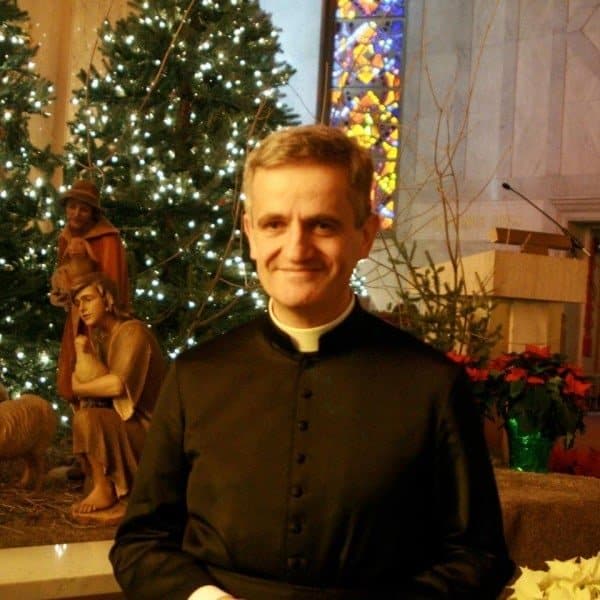
Canon Benoit Jayr
Canon Benoît Jayr
I recently met with the rector of the parish, Canon Benoît Jayr, a native of Montauban, France, who has been at Saint Stanislaus since 2011. He filled me in on the particulars of the fascinating restoration project currently underway at the parish. He showed me old photos dating from the golden age of Saint Stanislaus, which now serve as invaluable reference points for the ongoing work. We also discussed parish life, the allure of the Latin Mass, the importance of tradition, and his Montauban-to-Milwaukee transition.
 What is the driving motivation behind the renovations at Saint Stanislaus? Some might say, “What’s the point?” Is this just about one’s aesthetic preference over another’s?
We have a beautiful Polish inheritance here and, I believe, we have a solemn duty to preserve that patrimony. The continuity and preservation of these traditions, even in terms of architecture, are extremely important for the missionary impact of Saint Stanislaus, which is, of course, the conversion of souls. The parish building itself is well-known. Visitors who arrive at Mitchell International Airport will see the church recreated, along with other famous Milwaukee buildings, in a colorful floor mosaic. So already, the church greets visitors even before they see the actual building. We can also say that the building itself is a tool for evangelization, and not just a historical building. When talking about the decision to restore the original integrity of the interior I must add that many of the 1960s renovations are totally opposed to the basic architectural style of the original building. Anyone will notice that the modern windows and the renovated sanctuary, for example, are not congruous with the original design.
In your view, what was the reason why so many of these radical and financially exorbitant renovations took place in Catholic churches across America in the 1960s and after? For example, what inspired the removal of altar rails?
In the Church, and in society in the 1960s, we saw a big desire to change everything. It was a time of great turnover, we could say, and of innovation. The scope of such renovations in church buildings was allegedly to give more dynamism. It was supposed to represent a new spring for the Church. But this season was disappointing, as the promised fruits did not show up....

Read the rest of the great article and interview at Cream City Catholic!

Thursday, May 30, 2013

Positive signs for the Catholic Church

There are amazing things happening right now. 

The Extraordinary Form of the Mass is beginning to have some influence in the church again.  So much so that Bishops across the world are trying their best to stifle the Reform of the Reform brought to you by the likes of Benedict XVI, Archbishop Lefefvre, Michael Davies, Cardinal Burke, Bishop Bruskewitz and so forth.  Prelates with authority around the world are feeling a little hot around the collar seeing their spirit of the council under attack, and all their work being undone faster than they could have imagined.  It has been made known that many of the modernists were pushing for Francis to rid the Holy See of Monseigneur Marini as Master of Ceremonies, only to be told by Pope Francis that he will remain and that they should not prevent the Traditions of the faith from influencing the faithful.  Many of the more traditional fold are concerned with this papacy in that he is not really into the liturgy and its reform as Benedict was in his later years, but we all need to remember that the restoration of the faith from the modernists influence will not
necessarily happen from the top down, but rather it will occur from the bottom up.  Different dioceses will have to take different steps in restoring some of the traditional influences.  For instance here in Milwaukee there is really only one Parish that offers the EF at this time but we are a growing parish and faithful to the magestarium.  Other dioceses see the OF and EF being offered side by side and this is to be encouraged. 

The internet has become a new public square for debate.  This is probably the most impressive thing to come about because we as faithful Catholics now have an amazing opportunity to evangelize the world from our computer then go out into our own streets like St. Pauls Steet Evangelization is doing now.  This is a tremendous opportunity to make disciples of all nations and the flame of the Faith is being kindled by the young and the old.  Dissidents are being called out for their errors by the common people of the church and those in the clergy faithful to the magisterium.  We must be vigilant yet charitable in our evangelization, but the fruits of internet are not limited to this.  Voices from different perspectives of orthodox Catholicism are able to address differences on a daily basis while influencing the faithful, pushing them to strive in the pursuit of truth. Blogs like Rorate-Caeli, The Remnant and What Does the Prayer really say are able to directly take on the postings of dissident blogs like the National Catholic Reporter, setting the record straight.  Vlogs like Church Militant.tv and the many on YouTube are creating a virtual encyclopedia of Cathlicity, and the comment sections underneath the videos are a grace because it allows for swift corrections to be made when necessary.  Over enthusiastic ecumenism and inter-religious dialogue are also being addressed by the faithful on the internet, holding prelates to task for their erroneous was such as Jihad Watch and Harvesting the Fruits of Vatican II.  The Internet is such a fantastic tool capable of supreme good or supreme evil.  Let us continue to build on these goods.

One final thing, but surely not the last thing, that is encouraging is the restoration of Catholic traditions that serve as public and private witnesses to the faith like Adoration and Eucharistic processions.  The obvious good of these actions can be seen in the results when compared with parishes that have not restored such things.  Pews are fuller, vocations are up and faithfulness to the magisterium is mandatory.


These are just a few ideas for positive movements over the last decade or so.  Any other ideas?


+JMJ+

Thursday, April 11, 2013

Dear Patheos and Register Catholics on matters of holocaust deniers and Latin

Hi, Its good to hear that you have opinions on issues, so do I and I also have distinctions to make regading your presumptions.

First we dont go to the Extraordinary Form because we love Latin, that would be like saying you are a Christian because Jesus was a good teacher.  We love the TLM because of everything that organically became the Mass of the Saints.  Latin is great but if a novous ordo is said in Latin with all the things that were thrown together haphazardly in the 70's its still not appealing to us.  Thats not to say its not valid or illicit, of course it is, that was decided at the top level, "Rome has spoken the case is closed" after all.  I happen to go to a local Jesuit Parish which only offers mass in the ordinary form during the week so I am not against it, but I dont promote it like I do the TLM.
Its not just the Latin, but the prayers, and all the organically developed practices that make up the ancient rite which were thrown in the trash bin for whatever reason (perhaps confused ecumenism  im not sure).

Second just because a few so called traditionalists are anti-semetic doesnt mean we all must then proclaim that we are not.  Im not, but what does that matter to you? Its like saying Hitler was a Catholic and proclaimed such, therefore every Catholic must now come out of the woodwork and declare that they are against Hitler.  Ummmm, duh of course we are.  The people that are anti-semetic are the ones who push it out front like Williamson and this Gonzalez character who was referenced on Rorate.

Third the post by this Gonzalez was on the TLM in Buenos Aires which has been shown over and over again to be true.  SO what do bloggers do that dont like this info coming out say?  Well hes anti-semetic [?] so you automatically cant trust anything else.  This is not an ad hominum but a non-sequator.

There is my response,

+JMJ+

Monday, February 25, 2013

Pope Paul VI on Liturgical Reform: A Commentary


So I came across this article the other day in regards to an audience that Pope Paul VI gave on March 17th 1965 where he attempts to go through some observations about the liturgy’s reform.  I would remind the listener here that the audience does not specifically concern the 1970 missal commonly referred to today as the Ordinary Form of the Mass, but rather it is concerned with the 1965 Roman Missal that first followed S.C. in taking advantage of proposals contained within, as well as non-conciliar proposals that found their way in.  This commentary is the first of two examining the audience from my stance, but it is only an opinion as the second will be.

Before I go any deeper I want to make it clear this video is not about bashing Paul VI or the newer versions of the mass after the 1962 missal of Blessed John XXIII.  Instead this video is to point out that indeed some of the things that are commonly thought to be mostly abuses on the part of liturgical “reformers” in fact did have the highest support for what its worth, for better or for worse.  I hope that this video will help those of you out there think critically about some of the points made, but the commentary is entirely my own opinion and open to criticism from all.
So with that let’s begin.  I have posted the original article I found this on below as well as the Vatican website full text in Italian.  Use Google translate to translate the document for your own studies.
The title of the audience is labeled: 

The participation of the faithful at Mass


Dear Sons and Daughters! [Somewhat P.C. in comparison but for what it’s worth not a big deal to me because these are informal addresses]

Our family conversation in a hearing like this, it cannot return to the topic of the day: the implementation of the liturgical reform in the celebration of Holy Mass. Our desire would be to ask you, if the public nature of this meeting not prevented, as we do in other meetings of a private nature, what are your impressions about this great news. It deserves that everyone will pay attention. Well, we think that your answer to our question would not be dissimilar to those that we reach these days.

[Notice the wording used in this audience it’s not about magersarial church teaching specifically, but more-so a father family conversation, and fairly informal at that.  After all a conversation doesn’t necessarily suppose a conclusion.  When Pope Paul asks for impressions about the news of the revised missal (1965 RM), he is, at least in my mind’s eye, rather jubilant at what is about to be discussed.  Whenever my family sits down at the dinner table and my Dad says something jovial to this effect something big is underway, as those attending the audience would later learn was in fact about to occur.  I also want to note how he asks for their impressions of the great news.  I would remind the viewer here of what happened after the revised missal came out last Advent when the people on both sides of the theological aisle where proclaiming it an objective failure to reach what was really needed for the Church.  I would also quickly remind the viewer that there is nothing wrong with having the conversation in the first place, but using such democratic terms when speaking of something so protected as the sacred liturgy over the years should concern even the average Ordinary Form goer that has some clue as to the importance of the liturgy and what it is.]


The liturgical reform? Can be reduced to two categories those answers. The first category is that of the responses noted some confusion, and therefore a nuisance: first, say these observers, it was easy, everyone could pray as she wanted, everything was known about the performance of the rite, and now everything is new, surprise , change, even the sound of the bell at the Sanctus was abolished, and then those prayers that you do not know where to go and find, that communion received standing, and the end of the Mass that ends in the trunk with the blessing, all of which meet Many moving, rituals and readings recited aloud. . ., In short, there is no peace and we understand less than before, and so on.

[I don’t know whether or not this whole issue can be reduced to two categories but I will hit that hopefully later.  It first notes that the first category is based on responses noting confusion, therefore a nuisance.  Confusion doesn't outright guarantee a nuisance by any standard.  Of course the translation could be off, but a nuisance is had when something is left unchecked to which I think part of this audience (although not seen by most of the faithful as today's are, sought to clarify the matter before the confusion developed into a nuisance.  He then delves into the concerns about the new form of the liturgy.  He mentions that the people protesting the change complain that prayer was freer, that actions in the worship were known.  In itself this is a caricature of why people were up in arms about the change, but I want to quickly hit this as spoken.  That people were freer to pray then they are now is a fascinating response.  Considering that I frequent the TLM usually about two days a week and the ordinary form about three to four days I do notice the difference that is being talked about.  When you at the Extraordinary form you can in fact (and most do) follow the missal which containing both the spoken Latin and vernacular translation and thus keep yourself focused directly on the actions visibly occurring in the sanctuary.  So too, and I do this less often, one can take the time while at the Holy Sacrifice to offer up prayers of any sort including the rosary which is so often maligned by people thinking that saying the rosary at mass is inappropriate because it disallows real focus to be had on that is actually occurring at that time.  I disagree with this thought because one can be praying at any mass in either form and not be directly focused on the very word, and also action proceeding from the one acting in persona Christi.  Just think of how many times when you hear a reading from scripture or a Eucharistic prayer your mind wanders and you miss the point of either.  Yet you hopefully were in a state of prayer when your find wandered.  See even with the vernacular we become familiar with what is said and not to say be dismiss it but it loses some of the luster that it is always to perpetuate.  Having the chance to focus your attention toward something like a set prayer like the rosary will enable the person to keep their mind always centered toward God.  What I am trying to say is that focus if centered toward the Lord is what we are expected of firstly at the Mass.  One of the things that was forgotten by ridding the liturgy of the bells is the quick response call to focus on what is about to happen concerning the very moment we are transported to Golgotha to take part in the Death of Christ.  I also wanted to make note of the non-scilant way that he brings up reception of the Blessed Sacrament standing.  Perhaps it’s the informal way the address was given but the way in which he receives us is very important.  Everything that occurs at the liturgy including our postures and our mindset speak to who God is and his expectations of his children.  I also wanted to speak to the last part of this paragraph which states: In short, there is no peace and we understand less than before, and so on.  I can actually agree to this statement of those questioning the change because there is an utter lack of silence in the mass and people are constantly called on to do something during every aspect of the mass whether sing or hold hands or motion with your hands one way or the other.  I came across a good article the other day on how silence is fundamental to the lived experience of the mass.  http://www.ignitumtoday.com/2013/02/21/tlm-praying-in-silence/
There is a question also as to whether we understand less than before, specifically as to whether some of the prayers now offered by the priest and faithful are somewhat ambiguous thus can lead people to misunderstand their true meaning.]


We will make no criticism of these observations, why should we show how they reveal poor penetration of the meaning of religious rites, and a glimpse not have a true devotion and a real sense of the meaning and value of the Holy Mass, but rather a certain spiritual indolence, who does not want to spend a few personal effort of intelligence and participation to better understand and better fulfill the most sacred of religious acts, to which we are invited, indeed obliged to associate.
 Repeat what these days by all the priests and pastors from all good teachers of religion has been saying: first, that occurs at the beginning some confusion and some discomfort is inevitable, it is in the nature of a practical reform, as well as spiritual, religious habits ingrained and widely observed, producing a little 'upheaval, not always pleasant at all, but, second, some explanation, some preparation, some will assist you soon remove uncertainty and damage the sense and the taste of a new order. Why, third, we must not believe that after some time you will return quiet and devout or lazy, as before, no, the new order will be different, and will have to stop and shake the liability of the faithful present at Mass, before enough help, now we must part, before the presence enough, now you need your attention and action, and before anyone could nap and maybe chat, not now, to listen and to pray. Hopefully soon celebrants and faithful will have new liturgical books and that these also reflect the new form, both literal and typography, the dignity of the previous ones. The assembly becomes alive and active; intervene means let the soul come into activity, attention, conversation, singing, action. The harmony of a Community act, performed not only with outward gesture, but with the inward movement of the feeling of faith and piety, the ritual gives strength and beauty special: it becomes a choir concert becomes, rhythm becomes d ' a huge flying wing to the heights of the mystery and joy of God.

[Ok so like the source I found this audience in I too find this statement to be incredibly frustrating to be nice.  First he says he is not going to offer criticism, then he attacks.  This seems to be the double mindedness that confuses so many in the church leading to perpetual nescience as he addressed before.  He then says “producing a little 'upheaval, not always pleasant at all, but, second, some explanation, some preparation, some will assist you soon remove uncertainty and damage the sense and the taste of a new order. “  Is there anyone else out there that immediately hears the Joker talking to Harvey Dent in the Hospital.  Maybe it’s just me.  I think the viewer can see the hatchet job that is about to be explained away for the sake of obtaining the sense and taste of a new order.  He then goes on and says: “after some time you will return quiet and devout or lazy, as before, no, the new order will be different, and will have to stop and shake the liability of the faithful present at Mass”.  It’s like he is speaking to children here, which many of us are liturgically speaking, but he also hits those who have a great love for the liturgy as said throughout the centuries.  I realize that maybe some people if not most people are lazy by nature but that in itself is not the fault of the liturgy but of the person.  It’s like the people that say ban guns because they kill people, and then ignore the person and why they chose to kill in the first place regardless of the means.  You see the gun like the mass ceases to be a means to salvation (death) and becomes the ends which would be our own personal disposition.  Having seen the results of the new mass since I was young I can boldly say that the innovations to shake the faithful has created a new clerical class of the laity confusing the importance of the priest, thereby calling into question his very purpose in the first place.  So too what is the deal with being quiet and devout during the liturgy.  If one’s mind is focused toward the sacrifice whether offering prayers or in song what does it mind them.  The focus should not turn inward with people so concerned that they are active that they forget the mass is said for them not because they are there.  Maybe it’s just me but sometimes you hear people say the church needs to change because if it does not they will look very foolish all by themselves.  To which I usually respond that the initial sacrifice was only attended to by those silent and devout among us (namely Mary and John and a small group of others).  He then says the following: “now we must part, before the presence enough, now you need your attention and action, and before anyone could nap and maybe chat, not now, to listen and to pray.”  If there is anything that I can’t stand its people napping and chatting and quite frankly I see none of this at the TLM and I am sure at faithful parishes with the ordinary form you don’t see this.  But the blanket statement that the new mass will somehow solve the problem is utterly frustrating.  People that nap or chat can do so whether people are supposedly expected to sing, dance or whatever, in fact try to talk at a low TLM and see the reaction of the other parishioners about.  One is either disposed toward God or he is not.  Those people were able to listen and pray before in the silence but the hyper active new liturgical movement he speaks of does lend itself to constant shifting, therefore constant confusion because people are expected to follow every aspect and if they are off they will be noticed for not being in sync.  I would note that if someone attends the TLM and is afraid of the awkwardness don’t worry most people as long as you’re not doing crazy things are calm, plus you can sit in the back.  Oh and do where something above casual because this won’t help the standing out thing if that’s your concern initially.  He then states that “The assembly becomes alive and active; intervene means let the soul come into activity, attention, conversation, singing, action.”  I want to note the obvious that action is not a merely physical aspect of ones disposition.  He specifically makes physical action the sole purpose of the liturgy.  I don’t want judge his mindset here but I do wish to call into question why he felt urged to make the statement in the first place…oh wait it was to eliminate confusion which becomes a nescience…I seem to see an opposite day pattern emerging.  “He then states: The harmony of a Community act, performed not only with outward gesture, but with the inward movement of the feeling of faith and piety, the ritual gives strength and beauty special: it becomes a choir concert becomes, rhythm becomes d ' a huge flying wing to the heights of the mystery and joy of God.” So my initial concern just brought but is calmed since he says it’s not just an outward gesture, so we can put the rifles down.  Problem solved as they say.]

Part 1 done... hope it was helpful, please dont use this as a bash piece just an honest thinking through the issues we now are dealing with.  Show your love for Peter, and his Brother Bishops with the Charity Holy Mother Church asks of us.

+JMJ+